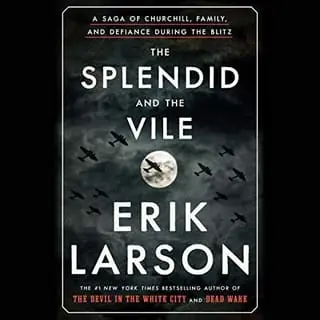
The Splendid and the Vile summary
by Erik Larson · 2020 · 7 key ideas · 17-minute read
Winston Churchill's first year as prime minister — from the fall of France through the Blitz — told through the diaries of his family, staff and ordinary Londoners.
Why read it
A gripping, intimate look at leadership under extreme pressure. It shows how one person, surrounded by flawed and fascinating people, kept a nation fighting when defeat seemed likely.
The Splendid and the Vile in brief
Larson covers exactly one year: from 10 May 1940, when Churchill became prime minister on the day Germany invaded the Low Countries, to May 1941, when London endured one of its heaviest raids and Rudolf Hess, Hitler's deputy, flew to Scotland on a bizarre solo peace mission.
In that year, Britain lost its main ally as France fell, evacuated its army from Dunkirk, fought the Battle of Britain in the air and suffered the Blitz, months of night bombing that killed tens of thousands of civilians. Churchill's task was to keep the country united and fighting, and to persuade the United States to help.
Larson tells this story from inside Churchill's circle, drawing on diaries and papers: his youngest daughter Mary, his private secretary John Colville, his daughter-in-law Pamela, his friend and minister Lord Beaverbrook, his scientific adviser Frederick Lindemann, and many ordinary diarists. Glimpses of Hitler's inner circle provide the counterpoint.
The result is a portrait of courage as something practised and performed: Churchill used speeches, presence, humour and hard decisions to teach a nation how to be fearless, while his family's ordinary loves and worries carried on beneath the bombs.
The 7 key ideas
1. Teaching a nation to be brave
Courage is contagious when leaders show it first.
2. Words as weapons
Tell the truth, then give people a part in the fight.
3. Resolve needs proof
Commitment is believed when it costs something.
4. Hire the disrupter
In a crisis, judge people by what they deliver.
5. Listen to the young expert
Good ideas don't check job titles.
6. Win your ally slowly
Alliances are built one conversation at a time.
7. Life goes on under the bombs
Keeping ordinary life going is a quiet kind of courage.
Read the full guide in Kinquire. Every idea with a real example, a diagram and one thing to try today, plus a quick quiz so it sticks. Free to start.
Read The Splendid and the VileKey takeaways
- Be visibly present and calm when your team faces danger.
- Pair honest bad news with a clear role for everyone.
- Back difficult high-performers in a crisis, while managing the costs.
- Seek out junior experts — the best insight may be low in the hierarchy.
- Protect small rituals of normal life under pressure.
Our take
The Splendid and the Vile is gripping, intimate and beautifully paced, making a much-told story feel fresh through private diaries and vivid scenes. Historians note that it adds little new scholarship and relies on well-known sources, sometimes favouring colourful gossip over analysis. Its portrait of Churchill is largely admiring, focusing on his finest year and leaving aside his imperial views and later controversies. Its view of ordinary Britons is filtered mostly through elite circles and Mass-Observation. As an immersive introduction to 1940–41 and a study of leadership in crisis, it works superbly.
About Erik Larson
Erik Larson is an American journalist and author of bestselling narrative histories, including The Devil in the White City and Dead Wake. He is known for writing non-fiction with the pace of a novel.
If you liked this
- The Rise and Fall of the Third Reich by William L. Shirer
- Sapiens by Yuval Noah Harari
- Guns, Germs, and Steel by Jared Diamond
- The Silk Roads by Peter Frankopan
- SPQR by Mary Beard
- 1776 by David McCullough