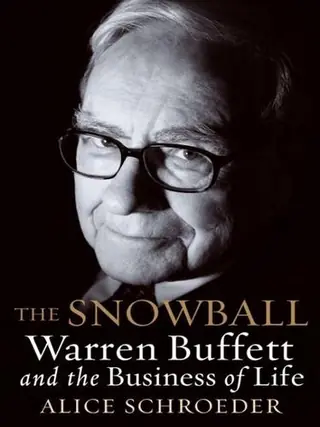
The Snowball summary
by Alice Schroeder · 2008 · 8 key ideas · 19-minute read
The authorised biography of Warren Buffett: how a boy obsessed with money and numbers built Berkshire Hathaway through patience, compounding and an 'inner scorecard' — and what it cost him personally.
Why read it
For anyone interested in investing, long-term thinking or integrity in business — and for an unusually candid look at the human being behind the legend.
The Snowball in brief
Warren Buffett was born in Omaha in 1930, the son of a stockbroker who became a congressman. From childhood he was fascinated by numbers and money. He sold gum and Coca-Cola door to door, ran newspaper routes in Washington, put pinball machines in barbershops and bought his first stock at eleven. He declared he would be a millionaire by 35.
At nineteen he read Benjamin Graham's The Intelligent Investor and found his calling. Rejected by Harvard Business School, he studied under Graham at Columbia, later worked for him, and then started his own investment partnership in Omaha in 1956. His early method was buying 'cigar butts': cheap, mediocre companies with a last puff of value.
Charlie Munger, a sharp Los Angeles lawyer, pushed him toward buying wonderful businesses at fair prices instead. Buffett took over a struggling textile mill, Berkshire Hathaway, and turned it into a holding company that bought insurers like GEICO, See's Candies, and big stakes in firms like the Washington Post and Coca-Cola.
Schroeder also shows his private life: an anxious, socially awkward young man who took a Dale Carnegie course to conquer his fear of public speaking; a husband whose wife Susie moved to San Francisco while they stayed married; a father often absent in thought. His rescue of Salomon Brothers in 1991 cemented his reputation for integrity.
The title comes from Buffett's metaphor: life is like a snowball, and what matters is finding wet snow and a really long hill. His fortune is the product of compounding over decades. In 2006 he pledged most of it to philanthropy, largely through the Gates Foundation.
The 8 key ideas
1. Wet snow and a long hill
Find wet snow, then give it a long hill.
2. Live by an inner scorecard
Keep score on the inside.
3. Learn from the masters
Knock until someone lets you in.
4. Go and see for yourself
Watch what people do, not what headlines say.
5. Wonderful businesses, fair prices
Quality compounds; bargains only flicker.
6. Reputation is everything
Lose money if you must; never lose your name.
7. Learn from costly mistakes
Spite is an expensive investment strategy.
8. The cost of a single focus
Relationships compound too — or they decay.
Read the full guide in Kinquire. Every idea with a real example, a diagram and one thing to try today, plus a quick quiz so it sticks. Free to start.
Read The SnowballKey takeaways
- Start compounding early and avoid big losses that reset progress.
- Judge yourself by your own principles, not by applause.
- Seek out mentors and go directly to the source of knowledge.
- Check big decisions with first-hand evidence.
- Pay fair prices for quality rather than bargains for junk.
- Protect your reputation above short-term gains.
Our take
The Snowball is exhaustively researched and unusually intimate, revealing Buffett's anxieties, family life and flaws alongside his genius. It is long, sometimes repetitive, and spends more time on personal life than on investment technique, so readers wanting a practical guide should turn to Buffett's shareholder letters. Buffett cooperated closely but reportedly felt uneasy about some of the personal revelations. As a portrait of character and compounding, though, it remains the definitive Buffett biography.
About Alice Schroeder
Alice Schroeder is a former insurance-industry analyst at Morgan Stanley. Buffett gave her extensive interviews and access to his family, friends and files for this book.
If you liked this
- The Intelligent Investor by Benjamin Graham
- The Psychology of Money by Morgan Housel
- Sapiens by Yuval Noah Harari
- Guns, Germs, and Steel by Jared Diamond
- The Silk Roads by Peter Frankopan
- SPQR by Mary Beard