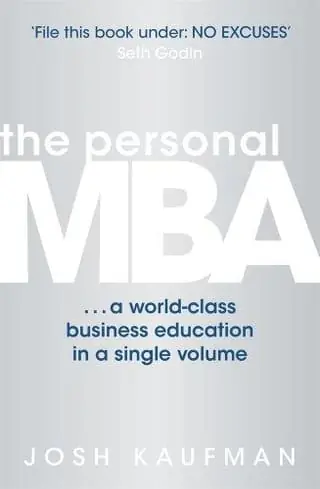
The Personal MBA summary
by Josh Kaufman · 2010 · 7 key ideas · 18-minute read
You can learn the essential ideas of business on your own: every business creates value, sells it and delivers it profitably, and a few hundred mental models explain how.
Why read it
For anyone who wants a solid grounding in how businesses work without the cost of business school — aspiring founders, freelancers, and employees who want to understand the bigger picture.
The Personal MBA in brief
Kaufman argues that the core ideas of business are not secret or complicated, and that a traditional MBA is an expensive way to learn them. Instead he offers a self-education: a broad set of short, clearly explained concepts drawn from many fields, organised so readers can build a mental map of how business works.
At the heart of the book is a simple model. Every business does five things: it creates something of value, attracts attention to it, persuades people to buy, delivers what it promised, and brings in enough money to keep going. If any of these is missing, it isn’t a business.
Around that core, Kaufman explains what people want, how to test ideas cheaply before committing, how money flows through a business, and how to grow revenue. He then turns to the human side: how our minds work, how to manage our own energy and focus, how to work with others and how systems behave.
The book reads more like a reference than a story, and can be dipped into in any order. Its value is in giving you a shared vocabulary and a practical checklist for thinking clearly about any business — your own, your employer’s, or one you’re about to start.
The 7 key ideas
1. Teach yourself business
The ideas are cheap; the discipline to learn them is the price.
2. Every business is five processes
Create, attract, sell, deliver, profit.
3. Understand what people want
Serve a real drive in a familiar form.
4. Test the market before you build
Let the market vote with money before you build.
5. Four ways to grow revenue
Count the levers before you chase new customers.
6. Start simple: Gall’s Law
Simple first. Complex later — if ever.
7. Manage yourself first
Do what matters first, while you still have the energy.
Read the full guide in Kinquire. Every idea with a real example, a diagram and one thing to try today, plus a quick quiz so it sticks. Free to start.
Read The Personal MBAKey takeaways
- Map your work onto the five processes and fix the weakest one first.
- Identify which core human drives your offer serves.
- Test demand with a minimal paid offer before building in full.
- Pull all four revenue levers, not just customer acquisition.
- Start with the simplest system that works and grow it gradually.
- Do your Most Important Tasks before anything reactive.
Our take
The Personal MBA is an excellent map of business fundamentals: clear, practical and remarkably broad. Its weakness is the flip side of that breadth. Many concepts get only a page or two, so it introduces ideas rather than teaching them deeply, and much of the material is borrowed from other authors. It also underplays what formal programmes do offer — networks, credentials and structured practice. Read it as a starting framework and a guide to further reading, not a complete education.
About Josh Kaufman
Josh Kaufman is an American business writer who worked in marketing at Procter & Gamble before going independent. He later wrote The First 20 Hours (2013), about learning new skills quickly.
If you liked this
- The Lean Startup by Eric Ries
- Rework by Jason Fried and David Heinemeier Hansson
- Good to Great by Jim Collins
- Built to Last by Jim Collins and Jerry I. Porras
- The Innovator's Dilemma by Clayton M. Christensen
- Blue Ocean Strategy by W. Chan Kim and Renée Mauborgne