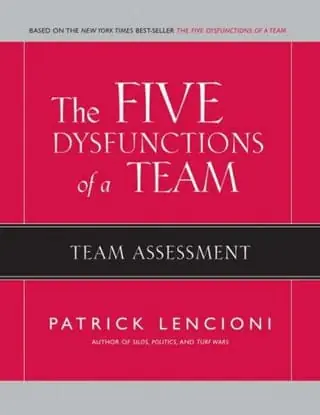
The Five Dysfunctions of a Team summary
by Patrick Lencioni · 2002 · 7 key ideas · 18-minute read
Teams fail in a predictable chain — no trust, so no conflict, so no commitment, so no accountability, so no results — and a leader can fix it from the bottom up.
Why read it
For anyone on, or leading, a team that feels stuck, polite or political. The story is quick to read and the model gives you a shared language to diagnose what's wrong.
The Five Dysfunctions of a Team in brief
Lencioni tells most of the book as a fable. Kathryn Petersen becomes CEO of DecisionTech, a Silicon Valley start-up with impressive money, technology and talent — but an executive team that can't work together. Meetings are polite and pointless, people protect their turf, and the company is falling behind.
Through a series of off-site sessions, Kathryn introduces a model of five dysfunctions, stacked like a pyramid. At the base is an absence of trust. Without trust, people fear conflict. Without conflict, they don't truly commit. Without commitment, they avoid holding each other accountable. And without accountability, people put their own status or department ahead of collective results.
The story shows how hard the fix is. Executives have to admit weaknesses in front of rivals, argue openly instead of nodding along, and call out colleagues who miss commitments. One senior executive resists the process and eventually leaves. Through all of it, Kathryn keeps returning everyone to the team's collective results.
The short final section lays out the model directly, with signs of each dysfunction and practical tools to overcome it: personal histories, behavioural profiles, conflict norms, clear commitments, public goals and team scoreboards. Lencioni's claim is that teamwork is rare not because it's complicated, but because it's hard and uncomfortable.
The 7 key ideas
1. Dysfunctions stack like a pyramid
Fix the foundation before you blame the roof.
2. Trust means being vulnerable
Trust is saying ‘I was wrong’ without fear.
3. Seek productive conflict
Silence isn't agreement — it's postponed conflict.
4. Commit without consensus
Be heard, then be all in.
5. Peers hold peers accountable
Great teams don't wait for the boss to say it.
6. Results over egos
One scoreboard, one team.
7. The leader goes first — and stays
Teamwork is simple to understand and hard to live.
Read the full guide in Kinquire. Every idea with a real example, a diagram and one thing to try today, plus a quick quiz so it sticks. Free to start.
Read The Five Dysfunctions of a TeamKey takeaways
- Diagnose your team using the pyramid, and start at the lowest weak level.
- As a leader, admit a mistake or weakness first to make honesty safe.
- Actively invite disagreement before decisions are made.
- End meetings by stating exactly what was decided and what will be communicated.
- Hold colleagues to shared commitments directly, not through the boss.
- Keep one visible scoreboard of the team's collective results.
Our take
The Five Dysfunctions is popular because it's readable and immediately useful: the pyramid gives teams a shared language and the fable makes it vivid. Its limits are also clear. The model is based on Lencioni's consulting experience rather than published research, and the neat, strictly sequential pyramid oversimplifies — real teams can show several dysfunctions at once. The fable's tidy ending, and its quick removal of one ‘problem’ person, can make change look easier than it is. Still, its core ideas line up with later research on psychological safety and are widely used in workshops.
About Patrick Lencioni
Patrick Lencioni is an American author and the founder of The Table Group, a management consulting firm focused on teamwork and organisational health. He has written a series of business books in fable form.
If you liked this
- Radical Candor by Kim Scott
- The Culture Code by Daniel Coyle
- Good to Great by Jim Collins
- Built to Last by Jim Collins and Jerry I. Porras
- The Innovator's Dilemma by Clayton M. Christensen
- Blue Ocean Strategy by W. Chan Kim and Renée Mauborgne