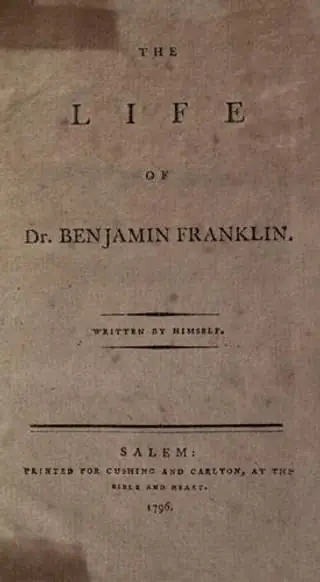
The Autobiography of Benjamin Franklin summary
by Benjamin Franklin · 1791 · 7 key ideas · 18-minute read
A runaway printer's apprentice explains, with wit and candour, how he made himself into a successful, useful and admired citizen.
Why read it
It's the original self-improvement book: practical methods for learning, building character, persuading people and getting civic projects done — still usable today.
The Autobiography of Benjamin Franklin in brief
Franklin began the memoir in 1771 as a letter to his son William, recounting his rise from humble beginnings. Born in Boston, one of many children of a candle and soap maker, he left school early, was apprenticed to his older brother James as a printer, and taught himself to write by imitating essays he admired.
At seventeen he ran away to Philadelphia, arriving almost penniless. After a misadventure in London, where a governor's promised letters of credit never appeared, he returned, built his own printing business and became known for hard work and reliability. He published a newspaper and Poor Richard's Almanack, and formed the Junto, a club for mutual improvement.
In the most famous passage, Franklin describes his 'bold and arduous project' of reaching moral perfection. He listed thirteen virtues and tracked his faults daily in a little book, focusing on one virtue a week. He admits he never achieved perfection but says the attempt made him better and happier.
The later parts describe his public projects: a subscription library, a fire company, street paving and lighting, an academy, a hospital and a militia. Along the way he shares his methods — modest language, sharing credit, asking favours of rivals. The book stops in the late 1750s, long before his role in the American Revolution.
The 7 key ideas
1. Teach yourself by imitation
Copy, wait, rebuild, compare.
2. A system for character
One virtue a week, one dot at a time.
3. The speckled axe
Aim for bright; don't quit when it's speckled.
4. Disagree modestly
Win the point, not the argument.
5. Ask a rival for a favour
To win a rival, ask for help, not approval.
6. Give away the credit
Nothing gets done faster than an idea nobody owns.
7. Industry — and being seen at it
Trust is built in public, one delivery at a time.
Read the full guide in Kinquire. Every idea with a real example, a diagram and one thing to try today, plus a quick quiz so it sticks. Free to start.
Read The Autobiography of Benjamin FranklinKey takeaways
- Learn a skill by copying a master, waiting, rebuilding it, then comparing.
- Work on one habit at a time and track slips daily.
- Don't let imperfection make you quit — count your progress.
- Use tentative language when you disagree to keep minds open.
- Ask a rival for a small favour to soften the relationship.
- Share credit freely to get big projects done.
Our take
The Autobiography is lively, funny and practical, and it shaped the American ideal of the self-made man. Its methods for learning, habit tracking and persuasion still hold up surprisingly well. But it is carefully curated: Franklin presents himself as he wished to be remembered, treats his worst mistakes lightly as 'errata', says little about his family life, and says little or nothing about his own ownership of enslaved people, which later historians have documented. The text also stops before the Revolution, so readers need a full biography, such as Isaacson's Benjamin Franklin, for the rest of his life.
About Benjamin Franklin
Benjamin Franklin (1706–1790) was a printer, writer, scientist, inventor and diplomat, and one of the founders of the United States. He wrote this memoir in several parts over nearly two decades and never finished it.
If you liked this
- How to Win Friends and Influence People by Dale Carnegie
- Atomic Habits by James Clear
- Sapiens by Yuval Noah Harari
- Guns, Germs, and Steel by Jared Diamond
- The Silk Roads by Peter Frankopan
- SPQR by Mary Beard