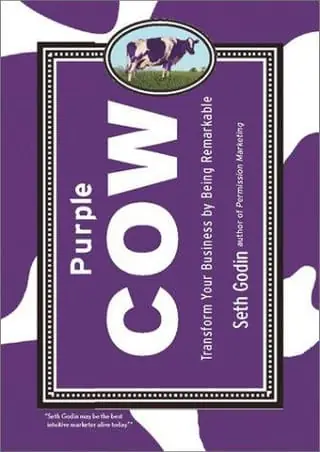
Purple Cow summary
by Seth Godin · 2003 · 7 key ideas · 17-minute read
In a world that ignores advertising, the only reliable way to grow is to build something remarkable — worth remarking on — and put it in front of the people who care most.
Why read it
For anyone launching a product, service or project into a crowded market. It's a short, sharp argument against playing it safe, and a prompt to build marketing into what you make.
Purple Cow in brief
Driving through France, Godin was charmed by herds of cows in the fields — for about twenty minutes. After that, cows were just cows. But a purple cow, he points out, would be worth looking at. That's the book's whole argument in a single image: in a crowded world, what isn't remarkable is invisible.
Godin argues that the era of the “TV-industrial complex” is ending. For decades, companies made average products for the masses and used advertising to sell them. Now people have too many choices and too little time, and they tune ads out. Marketing can no longer rescue a boring product.
So the remarkable must be built into the product itself. That means taking risks, because safe and “very good” are, in practice, the riskiest options. It means designing for the edges — the enthusiasts, early adopters and obsessives who care most and who spread ideas to everyone else.
Godin's advice is to identify those idea-spreaders, create something they'll talk about, make it easy for them to share, and then milk the success while it lasts. And when it fades, as every cow eventually does, start looking for the next purple one.
The 7 key ideas
1. Be a purple cow
Very good is just another brown cow.
2. The TV-industrial complex is over
You can't advertise your way out of boring.
3. Safe is risky
Boring always fails. It just fails quietly.
4. Market to the sneezers
Win the sneezers. They'll spread the cold.
5. Design for the edges
Average is for everyone, which means it's for no one.
6. Put the marketing inside the product
The product is the ad.
7. Milk the cow, then find another
Every purple cow eventually turns brown.
Read the full guide in Kinquire. Every idea with a real example, a diagram and one thing to try today, plus a quick quiz so it sticks. Free to start.
Read Purple CowKey takeaways
- Ask whether your product is worth remarking on before planning any promotion.
- Treat “safe and very good” as a real risk of invisibility.
- Identify the early adopters and sneezers in your market and design for them.
- Build at least one remarkable element into the product, packaging or service.
- Profit from success but keep funding the next experiment.
Our take
Purple Cow is short, punchy and memorable, and its warning about bland, committee-designed products still lands. It helped many creators see product and marketing as one job. But it's more a manifesto than a method: it says what to be, not exactly how, and its examples are chosen with hindsight, so it can't show how many bold bets failed. Its declaration that mass advertising is dead has aged unevenly — evidence-led marketers like Byron Sharp argue broad reach and familiarity still drive most brand growth. Read it as fuel for ambition, then check it against data.
About Seth Godin
Seth Godin is an American author and former dot-com executive; his company Yoyodyne was bought by Yahoo!, where he served as vice president of direct marketing. He has written over twenty books on marketing and work.
If you liked this
- This Is Marketing by Seth Godin
- Crossing the Chasm by Geoffrey A. Moore
- Contagious by Jonah Berger
- The Tipping Point by Malcolm Gladwell
- Zero to One by Peter Thiel with Blake Masters
- The Lean Startup by Eric Ries