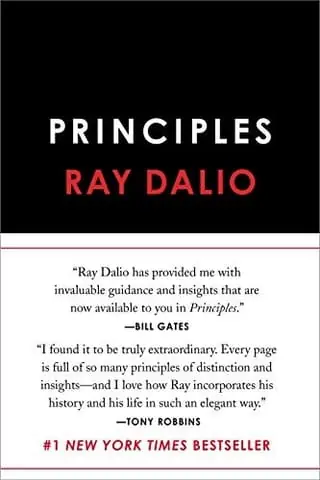
Principles summary
by Ray Dalio · 2017 · 7 key ideas · 18-minute read
Write down clear principles for how you deal with reality, learn from your mistakes through honest reflection, and build an organisation where the best ideas win regardless of who has them.
Why read it
For anyone who wants a systematic approach to decisions, mistakes and teamwork. Even readers who reject parts of Dalio’s culture find his habits of reflection and open-mindedness genuinely useful.
Principles in brief
The book has three parts. The first is autobiographical: Dalio describes growing up on Long Island, his early interest in markets, founding Bridgewater, and a near-ruinous mistake in 1982 that changed how he thought. That failure taught him to fear being wrong and to seek out people who disagreed with him.
The second part sets out his life principles. Reality works in cause-and-effect patterns, and we succeed by understanding and adapting to it rather than wishing it were different. He describes a five-step process for getting what you want, the formula that pain plus reflection equals progress, and the barriers — ego and blind spots — that stop us from seeing clearly.
The third part covers work principles: how he built Bridgewater as an ‘idea meritocracy’ based on radical truth, radical transparency and decisions weighted by people’s track records. He describes an organisation as a machine made of culture and people, which must be constantly diagnosed and improved.
Throughout, Dalio urges readers not to copy his principles blindly but to think for themselves, write down their own, and refine them through experience. Principles, in his view, are simply recorded lessons — ways of handling situations that recur — so that you don’t have to work out the same answer from scratch each time.
The 7 key ideas
1. Embrace reality and deal with it
Reality doesn’t care what you wish. Deal with what is.
2. Pain plus reflection equals progress
Don’t waste the pain — reflect on it.
3. The five-step process
Goals, problems, diagnosis, design, doing — then repeat.
4. Be radically open-minded
Seek disagreement. It’s free education.
5. Radical truth and radical transparency
Bad news early beats bad news late.
6. An idea meritocracy
Weigh opinions by track record, not title.
7. Manage the machine
Fix the machine, not just the moment.
Read the full guide in Kinquire. Every idea with a real example, a diagram and one thing to try today, plus a quick quiz so it sticks. Free to start.
Read PrinciplesKey takeaways
- Write down your own principles and refine them after each mistake.
- Treat pain as a signal to reflect, not something to escape.
- Use the five steps: goals, problems, diagnosis, design, doing.
- Seek out thoughtful people who disagree with you.
- Weigh opinions by track record and reasoning, not rank.
- Diagnose recurring problems as flaws in the machine, not just the person.
Our take
Principles offers a rare, detailed look inside a powerful thinker’s operating system, and its habits — reflecting on mistakes, seeking disagreement, weighing expertise — are widely useful. But it is long and repetitive, and many principles are general enough to feel obvious once stated. Its workplace prescriptions are contested: former employees and journalists have described Bridgewater’s culture as intense and high-turnover, and Rob Copeland’s 2023 book The Fund alleged a gap between the principles and practice, which Dalio disputed. Take the reflective habits; think carefully before importing the culture wholesale.
About Ray Dalio
Ray Dalio founded the investment firm Bridgewater Associates in 1975, starting from his New York apartment; it grew into one of the world’s largest hedge funds.
If you liked this
- Thinking in Bets by Annie Duke
- Radical Candor by Kim Scott
- Good to Great by Jim Collins
- Built to Last by Jim Collins and Jerry I. Porras
- The Innovator's Dilemma by Clayton M. Christensen
- Blue Ocean Strategy by W. Chan Kim and Renée Mauborgne