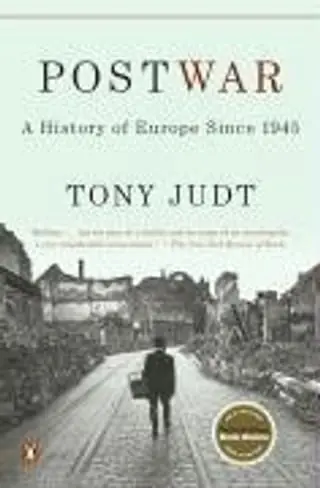
Postwar summary
by Tony Judt · 2005 · 7 key ideas · 19-minute read
How a continent in ruins in 1945 rebuilt itself, split in two, reunited and became today's Europe — and what it chose to remember and forget along the way.
Why read it
The definitive single-volume history of Europe since the Second World War. It explains the EU, the welfare state, the Cold War and Europe's politics of memory, all in one sweeping, opinionated narrative.
Postwar in brief
Judt begins with Europe in 1945: cities flattened, tens of millions dead, and millions of refugees and expelled people on the move. Rather than redrawing borders around people, as after the First World War, the victors largely moved people to fit the borders — creating more ethnically uniform nations.
Western Europe recovered remarkably fast, helped by American aid through the Marshall Plan and by a new spirit of pragmatic cooperation. Economic integration, starting with coal and steel, became the European Community. Mixed economies, planning and the welfare state delivered decades of growth and security. Meanwhile, the Soviet Union imposed communist regimes across the East, crushing revolts in Hungary in 1956 and Czechoslovakia in 1968.
From the 1970s, the postwar boom faded. Oil shocks and stagnation brought new economic ideas and governments like Margaret Thatcher's. In the East, communist economies decayed, and when Mikhail Gorbachev refused to use force to prop them up, the regimes fell in 1989 with astonishing speed.
The final part covers a reunified Germany, the expansion of the EU, and the wars in Yugoslavia, Europe's return to mass atrocity. Judt closes with an essay on memory, arguing that facing up to the Holocaust became central to what it means to be European.
The 7 key ideas
1. Moving people, not borders
Europe's peace was built partly on people moved by force.
2. Forgetting in order to rebuild
Silence can help you rebuild — but the truth waits.
3. America's catalyst
The best aid changes behaviour, not just balances.
4. Integration by self-interest
Shared interests outlast shared ideals.
5. The social-democratic bargain
Security isn't natural — it's built, and it can be dismantled.
6. How the East fell
Regimes fall when those who prop them up stop believing.
7. Memory as Europe's entry ticket
Memory protects only when it's still alive.
Read the full guide in Kinquire. Every idea with a real example, a diagram and one thing to try today, plus a quick quiz so it sticks. Free to start.
Read PostwarKey takeaways
- Look beneath success stories for the hidden costs that made them possible.
- Build lasting partnerships on clear mutual interest.
- Remember that social security and peace are political creations, not defaults.
- Question which 'permanent' systems in your life are actually fragile.
- Keep difficult memories alive through honest learning, not just ritual.
Our take
Postwar is widely regarded as a masterpiece: vast in scope, beautifully written and full of sharp judgements, bringing East and West into one story. Its focus is political, intellectual and cultural; some reviewers felt economics, social history and women's experiences got less space. Judt's strong opinions — for example his scorn for certain intellectual fashions — colour the narrative. Written in 2005, it predates the 2008 financial crisis, the eurozone troubles, Brexit and Russia's full-scale invasion of Ukraine, so its relatively hopeful view of Europe's trajectory reads differently today. It remains the essential starting point.
About Tony Judt
Tony Judt was a British-born historian who taught at Oxford and later at New York University, where he founded the Remarque Institute for the study of Europe. He died in 2010.
If you liked this
- The Rise and Fall of the Third Reich by William L. Shirer
- Sapiens by Yuval Noah Harari
- Guns, Germs, and Steel by Jared Diamond
- The Silk Roads by Peter Frankopan
- SPQR by Mary Beard
- 1776 by David McCullough