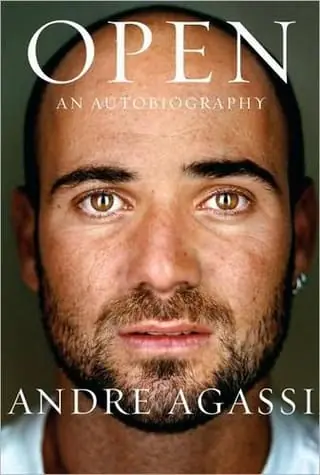
Open summary
by Andre Agassi · 2009 · 7 key ideas · 17-minute read
A tennis champion's raw confession that he hated the sport he was forced into — and how he found a reason of his own to keep playing.
Why read it
For anyone who has felt trapped in a life someone else chose for them, or who wants an honest look at pressure, identity and comebacks.
Open in brief
Agassi opens with a shock: he plays tennis for a living and hates it. Raised in Las Vegas by an intense father, a former Olympic boxer for Iran, he was drilled from early childhood against a ball machine he called 'the dragon'. At 13 he was sent to Nick Bollettieri's tennis academy in Florida, which felt to him like a prison.
He rebelled with outrageous hair and clothes, turned pro at 16 and became a star — and a marketing image. An advertising slogan, 'Image is Everything', stuck to him. He was secretly losing his hair and wore a hairpiece, which haunted him during big matches. Talented but erratic, he lost early Grand Slam finals before winning Wimbledon in 1992.
Coach Brad Gilbert taught him to win by strategy instead of perfection, and he reached No. 1. But his marriage to Brooke Shields was unhappy, his motivation collapsed, and in 1997 he used crystal meth, failed a drug test and lied his way out of punishment. His ranking fell to 141.
He rebuilt from the bottom, playing minor tournaments, and decided to play for a purpose: funding a school for at-risk children in Las Vegas. He won the 1999 French Open to complete a career Grand Slam and returned to No. 1. He married Steffi Graf and retired in 2006, at peace with a sport he had finally chosen.
The 7 key ideas
1. Excellence without love
Skill can be drilled; meaning must be chosen.
2. Image is not identity
The mask you sell can become the cage you live in.
3. Win ugly
You don't need perfect. You need one more ball in.
4. Start again from the bottom
Pride waits at the top; progress starts at the bottom.
5. Find a reason of your own
The same work feels different when it's for something.
6. No one wins alone
Even solo sports are team sports.
7. Tell the truth, eventually
Secrets get heavier the longer you carry them.
Read the full guide in Kinquire. Every idea with a real example, a diagram and one thing to try today, plus a quick quiz so it sticks. Free to start.
Read OpenKey takeaways
- Ask whether you're doing something for your reasons or someone else's.
- Drop images that no longer reflect who you are.
- Aim for consistency and strategy instead of perfection.
- When you fall, restart humbly at the level you're actually at.
- Connect your work to a purpose you care about.
- Build a small, trusted team even for solo pursuits.
Our take
Open is widely considered one of the best sports memoirs ever written, thanks to its honesty, vivid scenes and J. R. Moehringer's craft. It offers rare insight into the psychology of elite performance. Readers should remember it is Agassi's own perspective; his portrayal of his father, Bollettieri and some rivals, including Pete Sampras, has been disputed by others. The dramatic, novelistic style makes it gripping but sometimes compresses events. Still, its themes — pressure, identity, purpose — resonate far beyond tennis.
About Andre Agassi
Andre Agassi is a former world No. 1 who won eight Grand Slam singles titles, including all four majors. He wrote Open with the Pulitzer Prize-winning journalist J. R. Moehringer.
If you liked this
- Shoe Dog by Phil Knight
- Range by David Epstein
- Sapiens by Yuval Noah Harari
- Guns, Germs, and Steel by Jared Diamond
- The Silk Roads by Peter Frankopan
- SPQR by Mary Beard