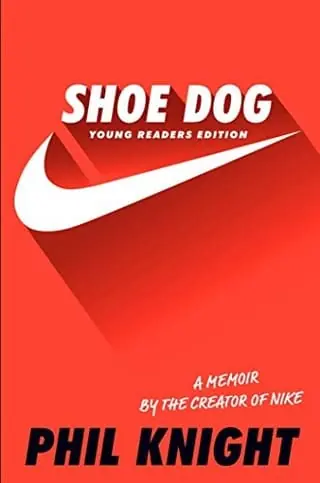
Shoe Dog summary
by Phil Knight · 2016 · 7 key ideas · 18-minute read
Nike's founder tells the messy, near-bankrupt, deeply human story of how a 'crazy idea' about Japanese running shoes became a global brand.
Why read it
For anyone starting something with more passion than money — it's an honest look at how close success sits to failure, and at what building a company costs.
Shoe Dog in brief
In 1962, 24-year-old Phil Knight, a former middle-distance runner, had what he called a crazy idea from a Stanford business-school paper: Japanese running shoes could do to German brands what Japanese cameras had done to German cameras. He set off on a trip around the world and, in Kobe, talked his way into becoming the American distributor for Onitsuka's Tiger shoes.
Back in Oregon, he sold shoes from the trunk of his car at track meets, while working as an accountant to pay the bills. His old coach Bill Bowerman became his partner, each putting in $500. A band of oddball early employees — the tireless letter-writer Jeff Johnson, the unflappable Bob Woodell — helped build the business.
Growth was fast but cash was always short. Banks repeatedly refused to extend credit, and the company lived from shipment to shipment. When Knight discovered that Onitsuka planned to drop him, he launched his own brand, Nike, with a $35 logo designed by a student, and won a court fight against his former supplier.
The 1970s brought more crises: a bank freezing their accounts, rescue by the Japanese trading company Nissho Iwai, and a $25 million demand for import duties from U.S. Customs. Through it all, the team kept selling and innovating, helped by Bowerman's experiments such as the waffle sole.
The memoir ends with Nike going public in 1980 and a reflective coda. Knight admits the price he paid — time away from his sons — and mourns his son Matthew, who died in a diving accident in 2004. He urges readers to find work that feels like play and never to stop.
The 7 key ideas
1. Follow the crazy idea
Let them call it crazy. Just don't stop.
2. Act as if, then deliver
Confidence opens the door; delivery keeps it open.
3. Growth eats cash
Profit is opinion; cash is fact.
4. Hire misfits, then trust them
Say what, not how — then get out of the way.
5. Tinker with what's at hand
A ruined waffle iron beats a perfect plan.
6. Don't depend on one partner
One supplier is a single point of failure.
7. Work as play — and its price
Run your race, but don't lose the people at the finish line.
Read the full guide in Kinquire. Every idea with a real example, a diagram and one thing to try today, plus a quick quiz so it sticks. Free to start.
Read Shoe DogKey takeaways
- Start the idea you can't stop thinking about, even before you're ready.
- Map when cash comes in and goes out — growth can starve you.
- Tell people what to achieve, not how, and let them surprise you.
- Prototype cheaply with what's at hand and test with real users.
- Avoid depending on a single supplier, client or platform.
- Protect time for the people your ambition could crowd out.
Our take
Shoe Dog is unusually candid and well written for a CEO memoir, with real self-doubt and vivid characters. It captures the chaos of an early-stage business better than most business books. Its limits come from its scope and narrator: it ends in 1980, so Nike's later controversies — especially the 1990s criticism of labour conditions in overseas factories — get only brief mention. Knight is also the hero of his own story, and some episodes, such as reading a partner's briefcase, are told with little critical distance.
About Phil Knight
Phil Knight co-founded Blue Ribbon Sports, which became Nike, with his University of Oregon track coach Bill Bowerman. He ran the company for decades and remains one of its best-known figures.
If you liked this
- The Ride of a Lifetime by Robert Iger
- Built to Last by Jim Collins and Jerry I. Porras
- Sapiens by Yuval Noah Harari
- Guns, Germs, and Steel by Jared Diamond
- The Silk Roads by Peter Frankopan
- SPQR by Mary Beard