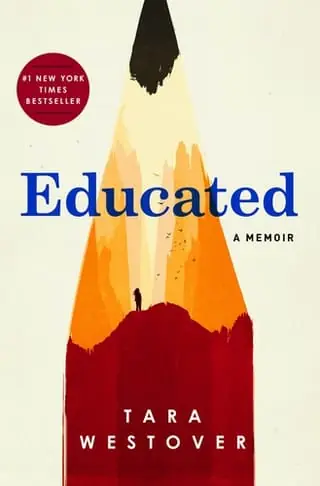
Educated summary
by Tara Westover · 2018 · 7 key ideas · 18-minute read
A woman raised by survivalists in rural Idaho, who never went to school, educates herself all the way to a Cambridge PhD — and pays for it with her family.
Why read it
For anyone who has outgrown the world they came from, or wondered how learning can change not just what you know but who you are.
Educated in brief
Tara Westover grew up on a mountain in Idaho with a father who distrusted the government, doctors and public schools, and who prepared constantly for the End of Days. She had no birth certificate until she was nine and never went to school. Instead she worked in her father's dangerous scrapyard and helped her mother, a midwife and herbalist, while injuries were treated at home.
Her older brother Tyler left to attend college and encouraged her to do the same. Teaching herself enough maths and grammar to pass the ACT, she was admitted to Brigham Young University at seventeen. There she discovered how much she didn't know — she had never heard of the Holocaust — and began to see her upbringing from the outside.
Her education accelerated: a study-abroad programme at Cambridge, a Gates scholarship, a visiting fellowship at Harvard and eventually a PhD. Each step widened the distance from home, where an older brother (called Shawn in the book) had been violent toward her, and where her parents dismissed or denied what had happened.
The final part describes her painful choice. Pressured to accept her family's version of events and her father's beliefs, she refused, and became estranged from her parents and several siblings. The book ends with her understanding of education as the creation of a new self — one able to hold her own mind, even at a great cost.
The 7 key ideas
1. You can't see your world from inside it
Normal is just the water you grew up swimming in.
2. Teach yourself the ladder
Confusion is the doorway, not the wall.
3. Ignorance is not neutral
What you don't know still shapes what you believe.
4. Memory is a reconstruction
Hold your memories humbly, but don't hand them over.
5. Whose story wins
Your experience deserves a fair hearing — including from you.
6. Loyalty or self
You can love people and still choose your own mind.
7. Education as self-creation
Education changes what you know — and who you are.
Read the full guide in Kinquire. Every idea with a real example, a diagram and one thing to try today, plus a quick quiz so it sticks. Free to start.
Read EducatedKey takeaways
- Seek outside perspectives to see your own assumptions.
- Treat confusion as a normal stage of learning, not a verdict.
- Learn the history of others to sharpen your own moral judgment.
- Hold memories humbly but don't let others erase your experience.
- Keep evidence when your account of events is being challenged.
- Recognise that growth can mean painful distance — and that's allowed.
Our take
Educated is beautifully written and widely praised for its honesty and its insight into the power of learning. Its candour about memory, including notes where relatives disagree, is unusual for a memoir. But it is one person's account: members of Westover's family have publicly disputed parts of it, and readers hear little from her parents' side. It is also an extreme story, so it should not be read as a portrait of rural, religious or homeschooling families in general, most of whom look nothing like hers.
About Tara Westover
Tara Westover grew up in rural Idaho and earned a PhD in history from the University of Cambridge. Educated, her first book, became a major international bestseller.
If you liked this
- Sapiens by Yuval Noah Harari
- Guns, Germs, and Steel by Jared Diamond
- The Silk Roads by Peter Frankopan
- SPQR by Mary Beard
- The Rise and Fall of the Third Reich by William L. Shirer
- 1776 by David McCullough