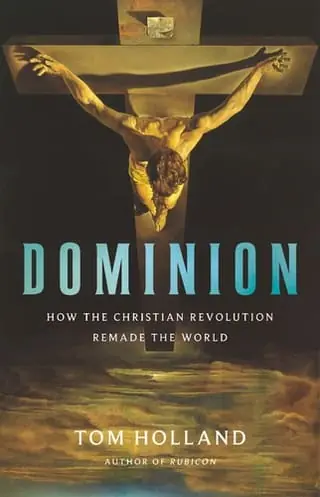
Dominion summary
by Tom Holland · 2019 · 7 key ideas · 18-minute read
How Christianity's shocking idea — a god crucified like a slave — quietly shaped the values of the modern West, including those of its secular critics.
Why read it
Whatever your beliefs, this book makes you see your 'common-sense' values — equality, human rights, compassion for victims — as products of history. It's bold, sweeping and well worth arguing with.
Dominion in brief
Holland describes how, after years writing about ancient Greece and Rome, he found their values more alien than he'd expected — especially their indifference to the poor and weak. He realised that his own instincts, though he no longer believed in God, were profoundly Christian. Dominion traces how that came to be.
He starts with the cross. In the Roman world, crucifixion was the most degrading punishment, reserved largely for slaves and rebels. That followers worshipped a crucified man as God turned ancient ideas of power upside down. Paul preached that in Christ there was neither Jew nor Greek, slave nor free, male nor female — a radical idea of universal human worth.
Over two thousand years, Holland follows this revolution through charity and hospitals in late antiquity, the medieval church's distinction between religious and secular power, the Reformation, the campaign to abolish slavery, the Enlightenment and the rise of human rights.
His most provocative claim is that modern secularism, liberalism and even atheism are deeply Christian in their assumptions. The West's values didn't simply replace Christianity; they grew out of it. Even movements that reject the church, he argues, often do so in the name of Christian ideals.
The 7 key ideas
1. The scandal of the cross
Christianity turned the ladder of power upside down.
2. Neither slave nor free
An idea can wait centuries to show its full force.
3. Charity becomes a duty
Charity that seeks no honour is the revolutionary kind.
4. 'Secular' is a Christian idea
Even the idea of a non-religious sphere has a religious history.
5. Christianity reforms itself
The sharpest critics often quote the founder.
6. Secular values, Christian roots
You can leave a religion without leaving its values.
7. The water we swim in
The values you can't see are the ones shaping you most.
Read the full guide in Kinquire. Every idea with a real example, a diagram and one thing to try today, plus a quick quiz so it sticks. Free to start.
Read DominionKey takeaways
- Question whether your 'common-sense' values are really universal.
- Learn where your moral instincts come from before defending or rejecting them.
- Hold institutions you belong to accountable to their own founding ideals.
- Practise charity that seeks no recognition.
- Read voices from other cultures and eras to see your own clearly.
Our take
Dominion is a dazzling narrative that makes a strong case for Christianity's long influence on Western values, and it has prompted wide debate among believers and non-believers alike. Critics argue it sometimes overstates Christianity's uniqueness, folding Jewish, Greek, Roman and Enlightenment contributions into a single Christian story, and selects episodes that fit the thesis. Its focus is overwhelmingly Western, with less on Eastern Christianity or the wider world. Holland does acknowledge Christianity's role in persecution and slavery. Read it as a provocative essay in historical form rather than the final word.
About Tom Holland
Tom Holland is a British historian and writer, known for books on the ancient world such as Rubicon and Persian Fire. He also co-hosts the history podcast The Rest Is History.
If you liked this
- Sapiens by Yuval Noah Harari
- SPQR by Mary Beard
- The Rise and Fall of the Third Reich by William L. Shirer
- Guns, Germs, and Steel by Jared Diamond
- The Silk Roads by Peter Frankopan
- 1776 by David McCullough