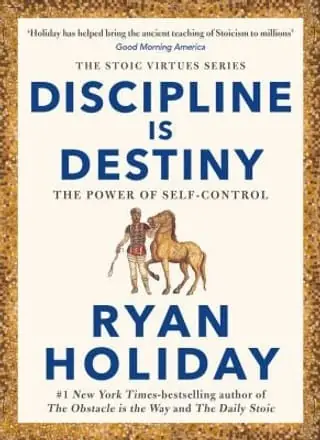
Discipline Is Destiny summary
by Ryan Holiday · 2022 · 6 key ideas · 15-minute read
Self-discipline — the Stoic virtue of temperance — is the quiet power behind every good life: rule your body, your mind and yourself, and you become free.
Why read it
For anyone who feels pulled around by impulses, distractions and moods, and wants a historical, philosophical case for self-control that's more inspiring than a productivity hack.
Discipline Is Destiny in brief
Holiday focuses on temperance, one of the four cardinal virtues of Stoicism alongside courage, justice and wisdom. He argues it may be the most important, because without self-control the other virtues can't be practised reliably. Courage without restraint becomes recklessness; ambition without discipline becomes greed.
The book moves in three stages. First, the exterior: mastering the body through training, sleep, simple living and restraint of appetites. Second, the interior: mastering the mind — focus, patience, temper, the willingness to do hard things and do them well. Third, rising above: how disciplined people use their self-mastery to lead, forgive and lift others.
Throughout, Holiday tells short stories of historical figures — athletes, writers, leaders, philosophers — to show self-discipline in practice. His recurring message is that discipline is not punishment or deprivation. It is a form of freedom: the person who rules themselves is not ruled by their impulses, by other people or by circumstance.
He also warns against discipline turning into harshness. The goal is moderation, not extremism; being strict with yourself should go with being generous and tolerant toward others. In the end, he argues, the small choices of self-command, made daily, add up to character — and character becomes destiny.
The 6 key ideas
1. Discipline is freedom
Whoever can't rule themselves will be ruled.
2. Start with the body
Show up for your body, and your will gets stronger.
3. Moderation, not extremes
Enough is a discipline too.
4. Master your temper and attention
Pause first. Then choose.
5. Do the hard thing, and do it well
Eat the hard thing first. Then sweat the small stuff.
6. Strict with yourself, generous with others
Be hard on yourself so you can be easy on others.
Read the full guide in Kinquire. Every idea with a real example, a diagram and one thing to try today, plus a quick quiz so it sticks. Free to start.
Read Discipline Is DestinyKey takeaways
- Treat discipline as freedom from impulses, not as punishment.
- Keep one physical discipline daily — sleep, movement or wake time.
- Aim for moderation; avoid swapping indulgence for harsh extremes.
- Pause before reacting, and protect your attention from distraction.
- Do the hardest task first and care about details no one sees.
- Hold yourself to high standards while showing patience to others.
Our take
Discipline Is Destiny is an elegant, readable case for self-control, and its insistence that discipline means freedom and moderation — not self-punishment — is a useful corrective to 'grind culture'. Its short historical vignettes make the ideas memorable. But the book is more inspirational than analytical. Its stories are selective and sometimes flattering portraits of complex figures, and many chapters repeat the same point with a new anecdote. It offers little engagement with research on self-control or with the circumstances that make discipline harder for some people. Readers wanting practical systems may prefer habit books; those wanting a philosophical reason to build them will find it here.
About Ryan Holiday
Ryan Holiday is an American author known for popularising Stoic philosophy in books such as The Obstacle Is the Way and The Daily Stoic. This is the second book in his series on the four Stoic virtues, after Courage Is Calling.
If you liked this
- Meditations by Marcus Aurelius
- The Obstacle Is the Way by Ryan Holiday
- Can't Hurt Me by David Goggins
- Atomic Habits by James Clear
- The Power of Habit by Charles Duhigg
- The 7 Habits of Highly Effective People by Stephen R. Covey