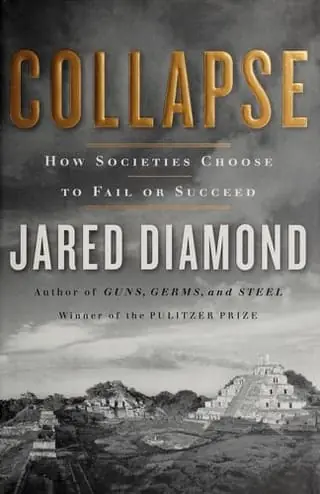
Collapse summary
by Jared Diamond · 2005 · 7 key ideas · 18-minute read
Why some past societies destroyed themselves while others survived — and what their choices about the environment mean for us.
Why read it
A sweeping, readable set of case studies — Easter Island, the Maya, Viking Greenland, modern Haiti — that turns environmental history into lessons about decision-making for any group under pressure.
Collapse in brief
Diamond asks why some societies, like the Classic Maya or the Norse in Greenland, collapsed, while others facing similar challenges survived for centuries. By collapse he means a drastic, long-lasting fall in population and political or economic complexity over a large area.
He proposes a five-point framework: environmental damage, climate change, hostile neighbours, loss of friendly trading partners, and — always crucial — how a society responds to its problems. He then tests it on past cases, from Easter Island and the Ancestral Pueblo of the American Southwest to the Maya and Viking Greenland, as well as success stories such as Tikopia in the Pacific and Tokugawa Japan.
Turning to the modern world, Diamond compares Haiti and the Dominican Republic, examines Rwanda's genocide in the light of population pressure, and looks at China and Australia. He asks why groups make disastrous decisions: failing to anticipate problems, failing to notice them, failing to try, or trying and failing.
Diamond ends cautiously optimistic. Because our problems are largely of our own making, he argues, they are within our power to solve — if we are willing to think long-term and reconsider cherished values.
The 7 key ideas
1. Five ways to fall
Pressures come from outside; collapse comes from the response.
2. The last tree on Easter Island
The last tree falls quietly; the damage happened long before.
3. When identity becomes a trap
Know which values to keep — and which to let go.
4. Why smart groups decide badly
Compare with ten years ago, not last year.
5. Insulated elites, shared ruin
Danger grows when deciders don't pay for their decisions.
6. Bottom-up and top-down success
Someone has to own the long term.
7. One island, two fates
Geography sets the stage; choices write the play.
Read the full guide in Kinquire. Every idea with a real example, a diagram and one thing to try today, plus a quick quiz so it sticks. Free to start.
Read CollapseKey takeaways
- Use the five-factor checklist to examine any organisation under strain.
- Compare today with years ago, not just last year, to spot creeping change.
- Ask whether decision-makers will feel the consequences of their choices.
- Be willing to give up values that no longer serve you.
- Assign clear responsibility for long-term stewardship of shared resources.
Our take
Collapse brought environmental history to a huge audience and offers a useful framework for thinking about how societies handle long-term threats. Its weaknesses are significant, though. Archaeologists and anthropologists, including contributors to the 2010 volume Questioning Collapse, argued that Diamond overstates 'collapse', underplays resilience and continuity, and can seem to blame victims — notably on Easter Island, where colonial violence and disease did great harm. Research since 2005 has revised parts of his Greenland and Easter Island cases. Read it for its questions and framework rather than as the final word on any single society.
About Jared Diamond
Jared Diamond is an American scientist and professor of geography at UCLA, best known for Guns, Germs, and Steel. Collapse is subtitled How Societies Choose to Fail or Succeed.
If you liked this
- Guns, Germs, and Steel by Jared Diamond
- Sapiens by Yuval Noah Harari
- The Silk Roads by Peter Frankopan
- SPQR by Mary Beard
- The Rise and Fall of the Third Reich by William L. Shirer
- 1776 by David McCullough