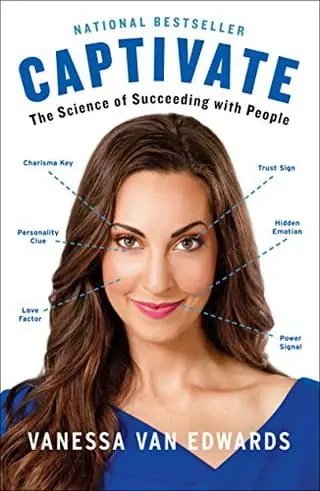
Captivate summary
by Vanessa Van Edwards · 2017 · 8 key ideas · 19-minute read
Social skill isn't a gift but a set of learnable habits — from first impressions and better questions to reading faces, personalities and values.
Why read it
For anyone who feels awkward at events, struggles with small talk or wants to understand people faster. It's a practical, research-flavoured toolkit for everyday interactions.
Captivate in brief
Van Edwards, who describes herself as a recovering awkward person, argues that people skills can be learned like any other skill. Drawing on psychology research and her own experiments, she offers a set of 'hacks' for the first five minutes, the first five hours and the first five days of getting to know someone.
The first five minutes are about impressions. Choose social settings where you'll thrive, use open, confident body language with visible hands, good posture and eye contact, and replace boring small talk with questions that spark real conversation. Look for common threads you can build on.
The next stage is understanding people more deeply. Learn to read facial expressions, especially brief flashes of emotion. Get a sense of someone's personality using the widely studied Big Five traits. Discover what they value most — such as status, information or love — so you can relate to them in ways that matter.
Finally, she looks at turning acquaintances into lasting relationships: asking for small favours, showing vulnerability, appreciating people in the way they like to be appreciated, and handling difficult people. The overall message is that understanding people is a skill — and it can be practised.
The 8 key ideas
1. Play where you thrive
Go where you glow.
2. The triple threat
Hands out, shoulders back, eyes up.
3. Spark better conversations
Ask about excitement, not occupation.
4. Find the common threads
Find the thread, then pull it gently.
5. Read the face
Read the face, then check with words.
6. Decode personality
Adapt to their wiring, don't fight it.
7. Know what people value
Give people what they value, not what you value.
8. Ask for help, show your flaws
Let people help you; let them see you.
Read the full guide in Kinquire. Every idea with a real example, a diagram and one thing to try today, plus a quick quiz so it sticks. Free to start.
Read CaptivateKey takeaways
- Spend more time in social settings where you thrive.
- Lead with visible hands, open posture and warm eye contact.
- Replace 'What do you do?' with a question that sparks a story.
- Look for common threads and follow them.
- Treat facial cues as hypotheses to check, not verdicts.
- Ask for small favours and admit small mistakes.
Our take
Captivate is engaging, practical and full of quick techniques, and its emphasis on curiosity, better questions and adapting to others is genuinely helpful. It draws on real psychology — the Big Five, similarity research, resource theory — and makes it accessible. But it sometimes presents contested science, such as microexpressions and power posing, with more confidence than the evidence supports, and many of Van Edwards' own experiments are informal rather than peer-reviewed. The 'hack' framing can make relationships sound like techniques to optimise. Used as a set of prompts for paying better attention to people, it is a useful, friendly guide.
About Vanessa Van Edwards
Vanessa Van Edwards is an American author and founder of Science of People, a company that researches and teaches interpersonal skills.
If you liked this
- How to Win Friends and Influence People by Dale Carnegie
- Supercommunicators by Charles Duhigg
- Never Eat Alone by Keith Ferrazzi
- Talk Like TED by Carmine Gallo
- Crucial Conversations by Kerry Patterson, Joseph Grenny, Ron McMillan and Al Switzler
- Nonviolent Communication by Marshall B. Rosenberg