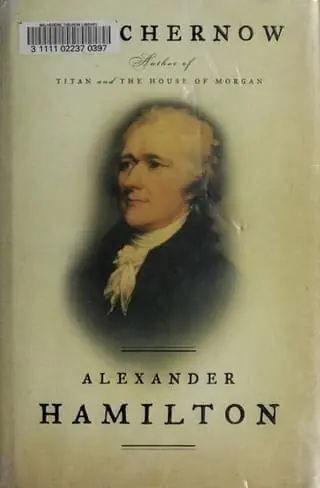
Alexander Hamilton summary
by Ron Chernow · 2004 · 7 key ideas · 18-minute read
The life of the orphaned immigrant who became America's first Treasury Secretary, designed its financial system, and destroyed himself through brilliance without restraint.
Why read it
For anyone interested in how institutions are built from scratch, how self-made people rise — and how talent can be undone by impulsiveness and pride.
Alexander Hamilton in brief
Hamilton was born on the Caribbean island of Nevis, illegitimate and poor. His father left, his mother died when he was a boy, and the cousin who took him in killed himself. Working as a clerk for a trading firm on St. Croix, he showed such ability that, after a vivid letter he wrote about a hurricane was published, local patrons paid to send him to North America to study.
In New York he threw himself into the revolutionary cause, writing pamphlets and leading an artillery company. He became George Washington's aide-de-camp, a central role he held for four years, then won the field command he craved and led a charge at Yorktown. He married Elizabeth Schuyler, from a powerful New York family.
After the war he pushed for a stronger national government, attended the Constitutional Convention and wrote most of The Federalist Papers to win ratification. As the first Secretary of the Treasury he established the nation's credit, created a national bank, built a customs service and promoted manufacturing, laying foundations of the modern American economy.
His brilliance came with enemies and blind spots. He feuded bitterly with Jefferson, Madison and Adams, and when his affair with Maria Reynolds became a weapon against him, he published a full confession. His son Philip died in a duel in 1801. In 1804 Hamilton was mortally wounded by Vice President Aaron Burr in a duel in Weehawken, New Jersey. His widow Eliza spent five decades preserving his legacy.
The 7 key ideas
1. Write your way out
Your words can travel where you can't.
2. Rise on merit, not birth
Make yourself indispensable.
3. Credit is trust
Trust is the currency behind every currency.
4. Build the machinery
Visions need plumbing.
5. Trade to win the big thing
Give what's cheap to you, get what's precious.
6. Brilliance without brakes
Being right isn't always worth saying.
7. The honour trap
Don't let your pride choose your battlefield.
Read the full guide in Kinquire. Every idea with a real example, a diagram and one thing to try today, plus a quick quiz so it sticks. Free to start.
Read Alexander HamiltonKey takeaways
- Write clearly and share your thinking — it opens doors.
- Make yourself useful to people doing important work.
- Keep your commitments; trust is your most valuable credit.
- Turn ideas into systems with checklists and procedures.
- In negotiations, trade what matters least to you for what matters most.
- Pause before answering attacks; pride is a poor adviser.
Our take
Chernow's biography is vast, vivid and deeply researched, and it transformed Hamilton's public reputation, inspiring Miranda's musical. It explains his economic achievements clearly and makes him a gripping human figure. But Chernow is sympathetic to his subject and tends to be harder on Jefferson, Adams and Burr. His portrait of Hamilton as a committed abolitionist has been challenged by later historians, who have found evidence that Hamilton was involved in transactions of enslaved people, at least on behalf of his in-laws. At over 700 pages, it is also a long read.
About Ron Chernow
Ron Chernow is an American historian and biographer whose books include Titan, about John D. Rockefeller, and Washington: A Life, which won the Pulitzer Prize. This biography inspired Lin-Manuel Miranda's musical Hamilton.
If you liked this
- Sapiens by Yuval Noah Harari
- Guns, Germs, and Steel by Jared Diamond
- The Silk Roads by Peter Frankopan
- SPQR by Mary Beard
- The Rise and Fall of the Third Reich by William L. Shirer
- 1776 by David McCullough