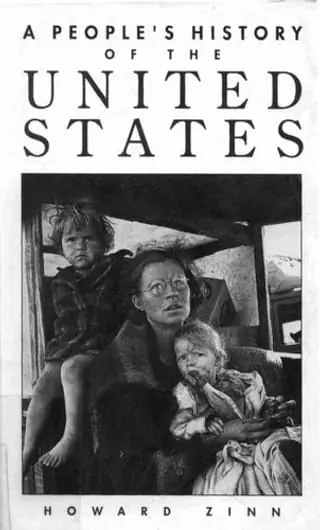
A People's History of the United States summary
by Howard Zinn · 1980 · 7 key ideas · 18-minute read
American history retold from the bottom up — through the eyes of Native Americans, enslaved people, workers, women and dissenters rather than presidents and generals.
Why read it
One of the most influential and most argued-over history books in America. It gives voice to people textbooks often leave out, and it trains you to ask whose story is being told. Read it alongside its critics.
A People's History of the United States in brief
Zinn openly rejects the idea of neutral history. Every historian chooses what to include, he argues, and traditional accounts tell the story from the viewpoint of the powerful — conquerors, presidents, industrialists. He chooses instead to tell it from the viewpoint of the conquered, the enslaved and the exploited.
He begins with Columbus's arrival in 1492 and the brutal treatment of the Arawak (Taíno) people, then follows the dispossession of Native Americans, the rise of slavery, and the ways colonial elites used racial divisions to keep poor whites and Black people from uniting.
In Zinn's telling, the Revolution and Constitution largely served the interests of wealthy colonists. Through the nineteenth and twentieth centuries he chronicles strikes, slave resistance, women's struggles, socialist movements and anti-war protests — and argues that real progress came from these movements, not from benevolent leaders.
Zinn presents wars, from Mexico to Vietnam, as serving elite interests, and reforms like the New Deal as concessions to defuse unrest. He ends by hoping that the middle classes — the system's 'guards' — will recognise their common interests with those below and help bring fundamental change.
The 7 key ideas
1. All history takes sides
Ask whose eyes the story is told through.
2. Columbus from the shore
Every 'discovery' was someone else's home.
3. Divide and rule
When the bottom fights itself, the top stays safe.
4. A revolution for whom?
Ask who wrote the rules — and who they protected.
5. Change comes from below
Rights are won from below, then credited above.
6. Reform as a safety valve
A concession can be a cure — or a pressure valve.
7. Dissent is patriotic
Loving your country can mean questioning it.
Read the full guide in Kinquire. Every idea with a real example, a diagram and one thing to try today, plus a quick quiz so it sticks. Free to start.
Read A People's History of the United StatesKey takeaways
- Always ask whose perspective a history is told from.
- Seek out sources from people who lost out in the official story.
- Notice when struggling groups are set against each other.
- Learn who fought for the rights you enjoy.
- Read Zinn and his critics together to form your own view.
Our take
A People's History brought millions of readers into contact with Native American, Black, women's and labour history that older textbooks often ignored, and it remains a powerful corrective. But many historians — including sympathetic ones on the left, such as Michael Kazin — criticise it as a morality play that divides the past into villainous elites and virtuous victims. They argue Zinn relies mostly on secondary sources, omits evidence that doesn't fit, rarely explains why ordinary Americans often supported the system, and treats complex leaders and reforms too cynically. Read it as a provocative counter-narrative, ideally alongside more balanced histories.
About Howard Zinn
Howard Zinn was an American historian and activist who served as a bomber crewman in the Second World War, taught at Spelman College and Boston University, and was active in the civil rights and anti-Vietnam War movements. He died in 2010.
If you liked this
- Sapiens by Yuval Noah Harari
- Guns, Germs, and Steel by Jared Diamond
- The Silk Roads by Peter Frankopan
- SPQR by Mary Beard
- The Rise and Fall of the Third Reich by William L. Shirer
- 1776 by David McCullough