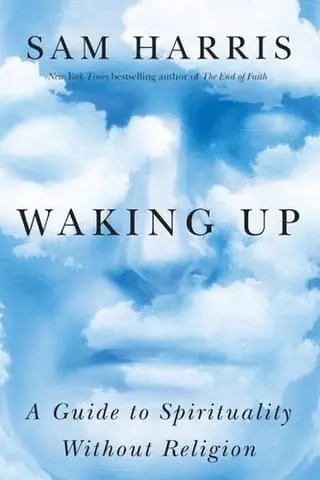
Waking Up summary
by Sam Harris · 2014 · 7 key ideas · 18-minute read
A neuroscientist and outspoken critic of religion argues that the core insights of contemplative traditions — especially that the self is an illusion — are real, testable in your own experience, and need no faith at all.
Why read it
For sceptical, scientifically minded readers who suspect there's something valuable in meditation but want it without dogma, superstition or mystical hand-waving.
Waking Up in brief
Harris, known as one of the 'New Atheists', begins by admitting something that surprises his readers: he thinks spirituality matters. By spirituality he means not belief in gods or souls, but the deliberate investigation of consciousness — and the discovery that our usual sense of self is mistaken.
He argues that consciousness is the most basic fact of our lives: the one thing we cannot doubt. Science has not explained how it arises from the brain, and Harris is honest about that mystery. But we can still study its contents directly, through careful attention.
The heart of the book is the claim that the self — the feeling of being a thinker behind your eyes, the owner of your thoughts — is an illusion. Harris draws on neuroscience, including split-brain research, and on meditative traditions such as Buddhist vipassana and Tibetan Dzogchen to show that this sense of self can be seen through.
He offers meditation instructions and argues that recognising the absence of a separate self can bring real freedom: thoughts arise and pass without anyone to be victimised by them. Mindfulness is the method; insight into selflessness is the goal. Calm is a welcome side effect, not the point.
The final chapter tackles practical pitfalls: abusive or deluded gurus, claims about life after death, and psychedelic drugs, which he believes can be revealing but risky. Throughout, his message is that the deepest benefits of contemplative practice are available to anyone willing to look closely, with no need to believe anything on faith.
The 7 key ideas
1. Spirituality without religion
Keep the practice, drop the dogma.
2. Consciousness comes first
Your life happens in consciousness — train it.
3. The self is an illusion
Thoughts arise; no thinker required.
4. The divided brain
Your brain narrates after the fact.
5. Mindfulness as investigation
Notice thoughts as thoughts — that's the whole game.
6. Look for the looker
Look for the looker; find open space.
7. Gurus, drugs and death
Bring your scepticism to the summit.
Read the full guide in Kinquire. Every idea with a real example, a diagram and one thing to try today, plus a quick quiz so it sticks. Free to start.
Read Waking UpKey takeaways
- Treat meditation as an experiment: observe your mind without adopting any beliefs.
- Notice regularly that you are aware, beyond the contents of experience.
- Practise catching thoughts as they arise rather than being lost in them.
- Look for the one who is thinking and see what you find.
- Keep a sceptical eye on gurus and extraordinary claims.
- Remember that the quality of your life is the quality of your attention.
Our take
Waking Up is one of the clearest arguments that meditation's deepest insights can be pursued rationally, and it gives sceptics an intellectually respectable entry point. Harris writes precisely and is honest about what science doesn't know. Its weaknesses: his dismissal of religion can feel sweeping, and religious readers may find his separation of 'insight' from 'doctrine' too neat. His preference for direct methods can sound dismissive of gradual paths. The claim that the self is an illusion is contested by philosophers, and his scientific support (like split-brain studies) illustrates more than proves it. Practical guidance is thinner than in a dedicated manual.
About Sam Harris
Sam Harris is an American author with a PhD in neuroscience from UCLA. He became widely known for The End of Faith (2004), a critique of religion, and later created the Waking Up meditation app.
If you liked this
- 10% Happier by Dan Harris
- The Power of Now by Eckhart Tolle
- Meditations by Marcus Aurelius
- Letters from a Stoic by Seneca
- The Enchiridion by Epictetus
- The Obstacle Is the Way by Ryan Holiday