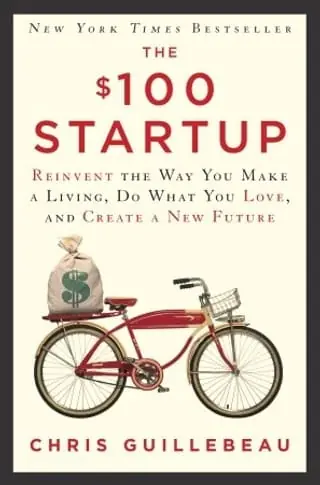
The $100 Startup summary
by Chris Guillebeau · 2012 · 7 key ideas · 15-minute read
Ordinary people are building small, profitable businesses with very little money by matching what they enjoy with what others will pay for.
Why read it
For anyone who wants more freedom from a side business or small venture, without big funding or a technical background. It is practical, encouraging and full of simple tools.
The $100 Startup in brief
Guillebeau studied people who had built businesses earning at least $50,000 a year, many of them starting with very little money, often around $100. Most had no business training. They ran what he calls microbusinesses: small operations, often one or two people, built around a skill or interest.
His central idea is convergence: success comes where something you enjoy or are good at meets something other people want and will pay for. Passion alone is not enough; usefulness is what turns a hobby into a business.
The book walks through the practical steps: finding an idea from skills you already have, writing a one-page business plan, building an offer people want, pricing it well, and launching it with a little drama. It favours action over planning, and testing over perfection.
Finally, it covers growing without losing what made the business enjoyable: getting more from existing customers, adding related products, and deciding how big you actually want to be.
The 7 key ideas
1. Find the convergence
Passion plus usefulness, not passion alone.
2. You have more skills than you think
Ask: what do people already come to me for?
3. Sell what people want
Sell more of what they want, less of what they don't.
4. The one-page business plan
A plan fits on a page. Then you begin.
5. Price on benefit, with a few clear options
Price the benefit, not your costs.
6. Launch like a movie
Create a little drama before you open the doors.
7. Grow on your own terms
Grow as big as your life needs, not bigger.
Read the full guide in Kinquire. Every idea with a real example, a diagram and one thing to try today, plus a quick quiz so it sticks. Free to start.
Read The $100 StartupKey takeaways
- Look for the overlap between what you enjoy and what people will pay for.
- List what people already come to you for; those are sellable skills.
- Describe your offer by its benefits, not its features.
- Write a one-page plan and start within a week.
- Price on the value you create, with a few clear options.
- Build anticipation before you launch.
Our take
The book is encouraging and practical, and its tools, like the one-page plan, are genuinely useful for beginners. It shows that small businesses can be built without much money. Its main weakness is selection: the people featured are success stories, chosen because they worked, so the book says less about how often similar attempts fail. Many examples are online or service businesses from the early 2010s, and some tactics have aged as online markets have become more crowded. As a confidence-builder and starting framework, though, it remains valuable.
About Chris Guillebeau
Chris Guillebeau is an American writer and entrepreneur who set out to visit every country in the world before he was 35, and runs a long-running blog about unconventional living.
If you liked this
- The 4-Hour Workweek by Timothy Ferriss
- Company of One by Paul Jarvis
- The Minimalist Entrepreneur by Sahil Lavingia
- So Good They Can't Ignore You by Cal Newport
- Zero to One by Peter Thiel with Blake Masters
- The Lean Startup by Eric Ries