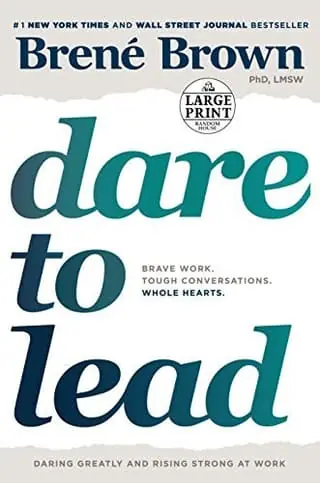
Dare to Lead summary
by Brené Brown · 2018 · 7 key ideas · 17-minute read
Courage is a set of teachable skills, and the foundation of brave leadership is the willingness to be vulnerable — to show up when you can't control the outcome.
Why read it
For leaders, and anyone who wants to have hard conversations, give honest feedback and build trust without hiding behind armour. It turns Brown's research on vulnerability and shame into practical workplace tools.
Dare to Lead in brief
Brown defines a leader as anyone who takes responsibility for finding the potential in people and processes, and has the courage to develop that potential. Her research with leaders led her to a central claim: courage isn't a trait you're born with but a collection of skills that can be learned, practised and observed.
She groups those skills into four areas. Rumbling with vulnerability: being willing to have hard, honest conversations while staying curious. Living into our values: knowing the one or two values you truly hold and turning them into specific behaviours. Braving trust: building trust through seven concrete behaviours. Learning to rise: getting back up after failure by examining the story you're telling yourself.
Throughout, Brown contrasts ‘armoured’ leadership — perfectionism, cynicism, needing to be the knower, using power over people — with ‘daring’ leadership, which is curious, clear and willing to be uncomfortable. Armour protects us from feeling exposed but stops us from connecting and learning.
The book is packed with phrases and tools teams can adopt: ‘clear is kind’, ‘the story I'm telling myself’, ‘paint done’, and the BRAVING checklist. Its message is that the cost of avoiding hard conversations is high, and that leaders who choose courage over comfort build cultures where people can do their best work.
The 7 key ideas
1. Vulnerability is the root of courage
No vulnerability, no courage.
2. Clear is kind
Clear is kind; unclear is unkind.
3. Rumble with curiosity
Get curious before you get certain.
4. Live two values, not ten
If everything's a value, nothing is.
5. BRAVING trust
Trust is built in marbles, not mountains.
6. The story I'm telling myself
It's a draft, not the truth.
7. Armour costs more than it protects
Armour keeps you safe and keeps you stuck.
Read the full guide in Kinquire. Every idea with a real example, a diagram and one thing to try today, plus a quick quiz so it sticks. Free to start.
Read Dare to LeadKey takeaways
- Say ‘I don't know’ or ‘I was wrong’ when it's true, especially as a leader.
- Before handing off work, paint what ‘done’ looks like in detail.
- Collect estimates and opinions privately before discussion.
- Choose one or two core values and define them as behaviours.
- Use ‘the story I'm telling myself is…’ to check assumptions before reacting.
- Diagnose shaky trust with the BRAVING checklist.
Our take
Dare to Lead gives teams a rich, practical vocabulary for courage and trust, and many organisations report adopting its phrases and tools. Its warmth and honesty are real strengths. The main criticisms concern evidence and style: Brown's research is qualitative and her data and methods aren't fully published, so her conclusions are better seen as well-grounded ideas than proven effects. The book can also feel long and repetitive, and its emphasis on emotional openness may sit awkwardly in some cultures or hierarchies where vulnerability carries real risks for less powerful people. Its core message aligns with research on psychological safety.
About Brené Brown
Brené Brown is a research professor at the University of Houston who studies courage, vulnerability, shame and empathy. Her TED talk ‘The Power of Vulnerability’ is one of the most-viewed TED talks.
If you liked this
- Daring Greatly by Brené Brown
- Radical Candor by Kim Scott
- Good to Great by Jim Collins
- Built to Last by Jim Collins and Jerry I. Porras
- The Innovator's Dilemma by Clayton M. Christensen
- Blue Ocean Strategy by W. Chan Kim and Renée Mauborgne