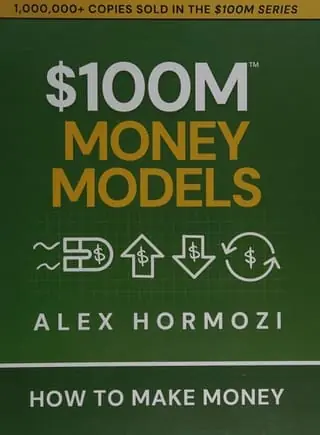
$100M Money Models summary
by Alex Hormozi · 2025 · 7 key ideas · 19-minute read
Design the sequence of offers a customer moves through so that each new customer pays you back, with room to spare, within 30 days.
Why read it
For anyone selling a product or service who feels stuck because winning customers costs money up front and only pays back slowly. It turns pricing and selling into a set of named moves you can mix and match.
$100M Money Models in brief
The third book in Hormozi's '$100M' series tackles a problem that quietly kills many small businesses. Winning a customer costs money now, but the customer only pays it back over months. While you wait, you can't afford to win the next one, and advertising tends to get more expensive over time, not less.
His answer is a money model: a deliberate sequence of offers designed to bring more cash in, from more of the people who show up, sooner. His target is blunt. In the first 30 days, a new customer should bring in more than twice what it cost to win and serve them. Hit that, and each customer pays for the next ones, so cash stops being the limit on growth.
He sorts every offer into four types. Attraction offers win the first purchase. Upsells get customers to spend more once they have said yes. Downsells turn a 'no' into a smaller 'yes'. Continuity offers get people paying again and again. Each type comes in several named versions, from 'win your money back' challenges to payment plans and bonuses for subscribing.
Most of the examples come from his own gyms, supplement and software businesses and from companies he invested in. The point is not to use every tactic, but to pick a few that suit your business and chain them into a sequence, like building blocks, so that what you earn early covers what you spend to grow.
The 7 key ideas
1. Get paid back within 30 days
Customers who pay you back fast can pay for the next ones.
2. Four kinds of offer
Get them in, raise it, rescue the no, make it repeat.
3. Attraction offers make the first yes easy
Don't give it away. Give them a reason to start now.
4. Upsell at the moment of yes
The yes is the start of the sale, not the end.
5. Turn a no into a different yes
Don't drop the price. Change the deal.
6. Continuity: get paid every month
One sale pays once. A happy subscriber pays every month.
7. Stack the pieces into a sequence
Not more offers. The right offers, in the right order.
Read the full guide in Kinquire. Every idea with a real example, a diagram and one thing to try today, plus a quick quiz so it sticks. Free to start.
Read $100M Money ModelsKey takeaways
- Check whether new customers pay back what they cost to win and serve within 30 days.
- Fill all four slots: attraction, upsell, downsell and continuity.
- Make your next offer straight after a yes, when customers are most motivated.
- Offer a payment plan or smaller version only after a clear no.
- Give people a real reason to join a recurring plan, and make leaving easy.
- Chain a few offers into a sequence instead of copying every tactic.
Our take
The book is unusually concrete: it names its tactics, explains when to use them and is honest that small businesses usually die from cash flow, not bad ideas. Its limits come from where it grew up. Many examples are from gyms, coaching and information products with high margins and in-person selling, where these sequences work best; low-margin retail has less room. Some tactics can slide into pressure selling if the product is weak, and the results quoted are mostly from Hormozi's own businesses rather than independent data. Rules on guarantees, prize draws and subscriptions vary by country, so check before copying an offer. Read it as a toolbox, not a promise.
About Alex Hormozi
Alex Hormozi is an American entrepreneur who started with a small gym, built Gym Launch, a business that taught gym owners his methods, and now runs the investment firm Acquisition.com with his wife, Leila. He also wrote $100M Offers and $100M Leads.
If you liked this
- $100M Offers by Alex Hormozi
- $100M Leads by Alex Hormozi
- Monetizing Innovation by Madhavan Ramanujam and Georg Tacke
- Influence by Robert B. Cialdini
- Zero to One by Peter Thiel with Blake Masters
- The Lean Startup by Eric Ries